If you’ve already applied for the West Bengal government’s monthly assistance programme for women, doing an Annapurna Bhandar Status Check 2026 is the only reliable way to know exactly where your application stands — whether it’s still being reviewed, has been sanctioned, or needs some action from your side. With well over a crore applications filed since the scheme opened, status pages are getting checked every day by applicants who simply want a straight answer instead of waiting and wondering. This guide covers the official way to run your Annapurna Bhandar Status Check 2026, what each stage of the result actually means, and how to avoid the fake “status check” sites that try to take advantage of applicants searching for the same thing.
What Is Annapurna Bhandar / Annapurna Yojana?
Annapurna Yojana — widely searched under its earlier working name, Annapurna Bhandar — is a monthly cash-assistance scheme for women in West Bengal. The state government notified it on 19 May 2026 and brought it into effect from 1 June 2026, with existing Lakshmir Bhandar beneficiaries migrated over automatically after verification, and a fresh online application window opened for new applicants. It is run by the Department of Women & Child Development and Social Welfare, and the portal itself is built and maintained by the National Informatics Centre (NIC), a central government technical body that hosts many official Indian e-governance sites.
By September 2026, the scheme had crossed 1.7 crore applications, with the government reporting roughly 1.5–1.58 crore women receiving the monthly payment and around 17 lakh applications rejected during verification — which is exactly why checking your individual status matters: being eligible on paper doesn’t guarantee the system has processed your case yet.
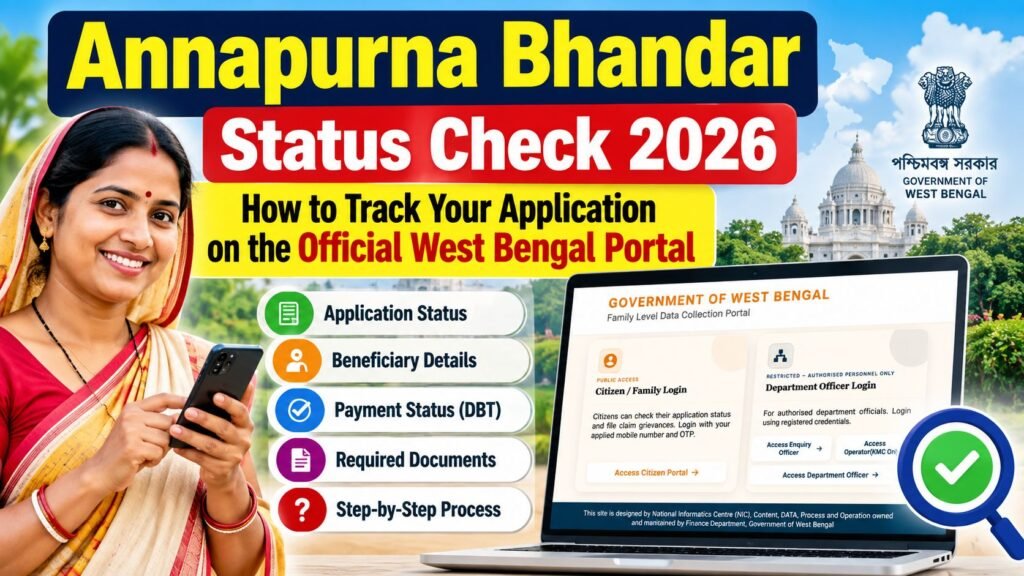
How to Check Annapurna Bhandar Status Step by Step
- Go directly to socialsecurity.wb.gov.in. Type the address yourself or use a bookmark — don’t click a link from an SMS, WhatsApp forward, or an ad claiming to offer “instant” status checks.
- Select “Track Applicant Status” on the homepage. The same page also shows a separate “Login (for Office user only)” option with a password field — that one is for government staff, not applicants, so don’t enter your details there.
- Enter what the page asks for. At the time of writing this is typically your registered mobile number, though the exact fields can be updated by the department, so follow whatever the live page currently requests rather than an old screenshot or guide.
- Complete the CAPTCHA or OTP verification shown, and submit.
- Read the result carefully — note the current stage of your application and any remark or instruction displayed, since a status can call for an action on your part (a missing document, a bank-linking issue) rather than just “approved” or “pending.”
Annapurna Bhandar Scheme — Quick Facts
| Detail | Information |
|---|---|
| Official Name | Annapurna Yojana (also called Annapurna Bhandar / Annapurna Bhandar Prakalpa) |
| State | West Bengal |
| Department | Women & Child Development and Social Welfare |
| Notified | 19 May 2026 |
| Effective From | 1 June 2026 |
| Monthly Benefit | ₹3,000 (₹36,000/year) |
| Payment Mode | Direct Benefit Transfer (DBT) to Aadhaar-linked bank account |
| Age Eligibility | Women, 25–60 years |
| Official Status-Check Portal | socialsecurity.wb.gov.in |
| Portal Built By | National Informatics Centre (NIC) |
| Status Facility | Track Applicant Status |
Documents You’ll Need on Hand
Before you even open the status page, keep these ready — the same documents the scheme lists as mandatory at the application stage:
| Document | Why It’s Needed |
|---|---|
| EPIC / Voter ID Card | Identity and electoral verification |
| Aadhaar Card | Identity check and DBT payment linkage |
| Active, Registered Mobile Number | Receiving OTPs, status updates, and portal access |
Who Is Eligible for Annapurna Yojana?
According to the scheme’s own conditions, a beneficiary must be:
- A woman aged between 25 and 60 years
- A permanent resident of West Bengal
- Not a permanent government employee, and not drawing a regular salary or pension from the state government, central government, a statutory body, panchayat, municipality, local body, or a government-aided educational institution
- Not an income-tax payer
Some independent reports have also mentioned income-linked conditions (a personal monthly income under roughly ₹10,000, and family income up to around ₹12 lakh a year) being applied during verification. These figures aren’t as consistently confirmed as the core criteria above, so treat them as a possible additional filter rather than a fixed rule, and confirm your own eligibility directly on the official portal or at your local block/municipal office rather than relying on any single website’s summary — this one included.
Payment Status: What to Check If Your Money Hasn’t Arrived
Monthly instalments have been going out roughly every few weeks since launch — the September 2026 round, for instance, was credited from 17 September and was publicly tied to the scheme’s monthly release cycle, reaching close to 1.5 crore women in that round alone. If you believe you’re eligible but haven’t been paid, work through this in order:
- Confirm your application is actually sanctioned, not just submitted or under verification — payment only happens after sanction.
- Check your Aadhaar-bank linkage. DBT fails silently if your Aadhaar isn’t correctly seeded to the bank account you expect the money in.
- Verify your bank account details on file are current — a closed account or a typo in the account number is a common, fixable cause of a missed payment.
- Re-check the official portal for any remark explaining a hold or rejection.
- Contact your local Block or Municipal office handling Annapurna Yojana applications if the issue isn’t resolved after the checks above.
Frequently Asked Questions
Can I check Annapurna Bhandar Status Check 2026 using just an Application ID? The official status page currently asks for your registered mobile number rather than a separate application ID field. If that changes, the official portal — not a third-party guide — is the authority on what’s required.
How much money does Annapurna Yojana actually pay? ₹3,000 every month, which works out to ₹36,000 over a year, paid by DBT directly into the beneficiary’s Aadhaar-linked bank account.
I was getting Lakshmir Bhandar — do I need to apply again? Existing Lakshmir Bhandar beneficiaries were migrated to Annapurna Yojana automatically, subject to the standard verification process, so most didn’t need to submit a fresh application — though it’s still worth confirming your own status on the portal.
Why does my status still say “under verification” weeks after I applied? With well over a crore applications filed statewide, verification by BDOs, SDOs, or KMC officers takes time. A long “under verification” status is common and isn’t the same as a rejection.
What should I do if my application was rejected? Check the remark shown against your application on the official portal for the stated reason, correct the issue if possible (a document mismatch or missing information, for instance), and follow the re-application process described on the official site or at your local welfare office.
Is there an app for checking Annapurna Bhandar status? As of now, the status-check facility is available through the official web portal rather than a dedicated mobile app — be cautious of any app store listing claiming to be the “official” Annapurna Bhandar app, since the scheme itself doesn’t point applicants toward one.
Can I apply offline if I can’t use the online portal? Yes. Besides the online route, the scheme has also been run through camps at the block and municipal level, where staff help applicants fill out the Family Level Data Collection form in person. The application still goes through the same verification pipeline, and status is still checked on socialsecurity.wb.gov.in afterward.
Does income affect whether my application gets sanctioned? Being an income-tax payer disqualifies an applicant outright, and some reports point to additional informal income thresholds used during verification. Since the exact income rules aren’t uniformly published across sources, the safest approach is to confirm your specific case with the officer handling your application rather than estimating eligibility from an income figure alone.